Parliament still lists an online betting levy as a fallback.
The five annual averages on the Commission page add to €44.0 billion. The research note's €58.2 billion also counts changes to resources that already exist.
- The 16 November note
- European Parliament research service, 16 November 2026, 'Possible EU own resource based on a digital levy'. It says the interim report asked for three further own resources to be explored: a digital-services tax, an online-gambling tax, and a tax on capital gains from crypto-assets. It says the April 2026 interim report endorsed the Commission's basket and asked that the new streams be adopted with the next multiannual financial framework.
- The five on the Commission page
- European Commission page on the 2028–2034 budget, proposal of 16 July 2025. Almost €2 trillion, or 1.26 percent of EU gross national income on average over those years. Annual averages: emissions trading about €9.6 billion; carbon border about €1.4 billion; uncollected electronic waste about €15 billion; tobacco excise about €11.2 billion; CORE, a lump sum from firms other than small and medium-sized ones with net annual turnover of at least €100 million, about €6.8 billion. Added, €44.0 billion. That addition is this paper's. The page does not print it. Gambling is absent from the five.
- The larger package
- The 16 November note says the new package, combined with proposed adjustments to existing own resources and their call rates, is estimated at about €58.2 billion a year. It does not show the sum. This paper does not treat €58.2 billion minus €44.0 billion as a measured adjustment.
- The fallback wording
- As the 16 November note prints the April report: a digital-services levy on major platforms, a levy on online gambling and betting services, an extension of the carbon-border mechanism, and a levy at a uniform call rate on capital gains from crypto-assets should be explored if other proposed own resources do not gain support among the member states, for tax fairness and for revenue that matches the need. This desk did not open the April report. The parliament document site did not load.
- The summit, on that note
- Talks on new own resources have made limited progress. Member states are reluctant to raise national contributions by much. Parliament still wants an ambitious agreement on own resources inside the next framework. European Council president António Costa is preparing a compromise on own resources ahead of a special European Council on 26–27 November 2026, on the long-term budget and financing for Ukraine. This desk did not open the Council invitation.
- What stays with the trade paper
- SBC News, 18 November 2026. Ireland, holding the Council presidency, is brokering. An update was due on 13 November and nothing further was announced. The negotiating text is still about €1.65 trillion and covers NextGenerationEU debt repayment. France, Germany and Italy are expected to lift contributions to 1.4 percent of gross national income. This desk did not open a Council draft, a presidency note, or a national-contribution table.
On 16 November the European Parliament’s research service set an online gambling levy beside the talks on the next long-term budget. The note is about a possible own resource drawn from a digital levy. Its opening says Parliament’s interim report asked for three further resources to be looked at: a tax on digital services, a tax on online gambling, and a tax on capital gains from crypto-assets. SBC News wrote the note up on 18 November.
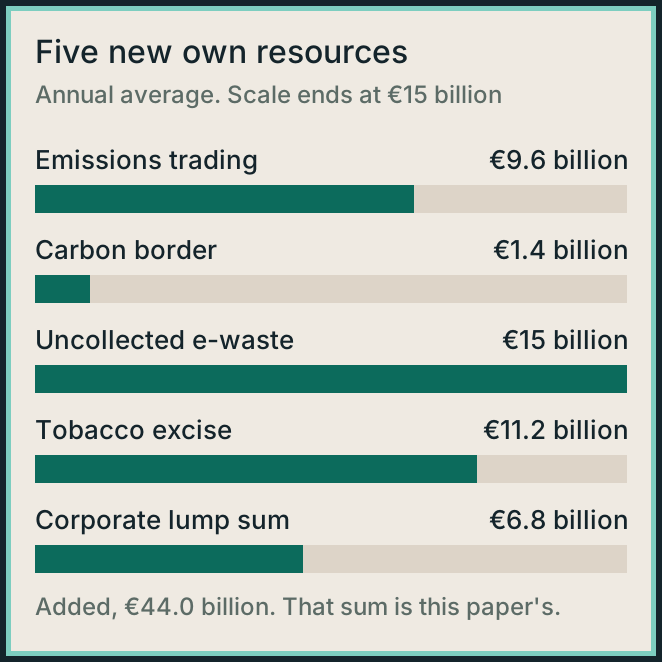
The Commission’s list is the one already on the table. This desk opened the Commission’s page on the budget for 2028 to 2034. The proposal is dated 16 July 2025. It asks for almost €2 trillion, which the page also writes as 1.26 percent of the Union’s gross national income on average across those years. The five new own resources, with the annual averages the page prints, are a share of emissions-trading revenue, about €9.6 billion; a share of the carbon-border mechanism, about €1.4 billion; a charge on electronic waste that is not collected, about €15 billion; a tobacco-excise resource, about €11.2 billion; and a corporate lump sum, called CORE, from firms other than small and medium-sized ones with net annual turnover of at least €100 million, about €6.8 billion.
Added, those five averages are €44.0 billion a year. That addition is this paper’s. The page does not print the sum. A levy on gambling is absent from the five.
The research note puts a larger figure on the package. It says that, taken with proposed adjustments to own resources that already exist and to the rates at which they are called, the package is estimated at about €58.2 billion a year. It dates the five proposals to 16 July 2025 and links the Commission’s budget page. It does not show how the five lines become €58.2 billion. This paper does not treat the gap between €58.2 billion and €44.0 billion as a measured adjustment.
The gambling line is the fallback, and it is older than this week’s note. The research service says that in April 2026 the interim report endorsed the Commission’s basket and asked for the new streams to be adopted with the next multiannual framework. It then prints the report’s argument. Four ideas should be explored if the resources already proposed do not win the member states: a levy on digital services at the large platforms, a levy on online gambling and betting services, a wider carbon-border mechanism, and a levy that takes a uniform share of capital gains on crypto-assets. The aims named with that list are a fairer tax and revenue equal to the need. This desk did not open the April report. The parliament document site did not load. The list above is the 16 November note’s printing of it.
The same note says the talks on new own resources have made limited progress, that member states are unwilling to raise national contributions by much, and that Parliament still wants an ambitious deal on own resources inside the next framework. It says European Council president António Costa is preparing a fresh compromise on own resources before a special European Council on 26 and 27 November 2026, given over to the long-term budget and to financing for Ukraine. This desk did not open the Council invitation linked from that sentence.
The Commission’s page, which did load, sets the procedure. Member states decide the long-term budget and the revenue system in the Council, and they must be unanimous. The multiannual framework also needs the European Parliament’s consent. Where the revenue rules require it, national parliaments ratify them.
SBC News supplies the state of the draft, and those points stay with the trade paper. It says Ireland, which holds the Council presidency, is brokering the talks. It says an update was due on Friday 13 November and that nothing further was announced. It says the negotiating text is still about €1.65 trillion and already covers repayment of the NextGenerationEU debt. It says the Union is seeking at least €2 trillion, and that France, Germany and Italy are expected to lift their contributions to 1.4 percent of gross national income. The Commission’s page uses a different pair for the size of the proposal: almost €2 trillion, and 1.26 percent of Union gross national income. This desk did not open a Council draft, a presidency note, or a national-contribution table.
The research note also records a budgets-committee workshop on a digital levy, with revenue ranges from two invited experts. Those ranges concern a tax on digital services. They are left out of this note.
The 16 November note sets no rate, no base and no yield for the gambling levy. It names the levy as one option to study if the resources already proposed fail.