Macau's volumes rose. Sands' quarter did not.
Mass share reached 26.1 percent, the strongest since the fourth quarter of 2023. Macau earnings still fell, Londoner hold was low, and the parent spent the quarter buying stock.
- Group
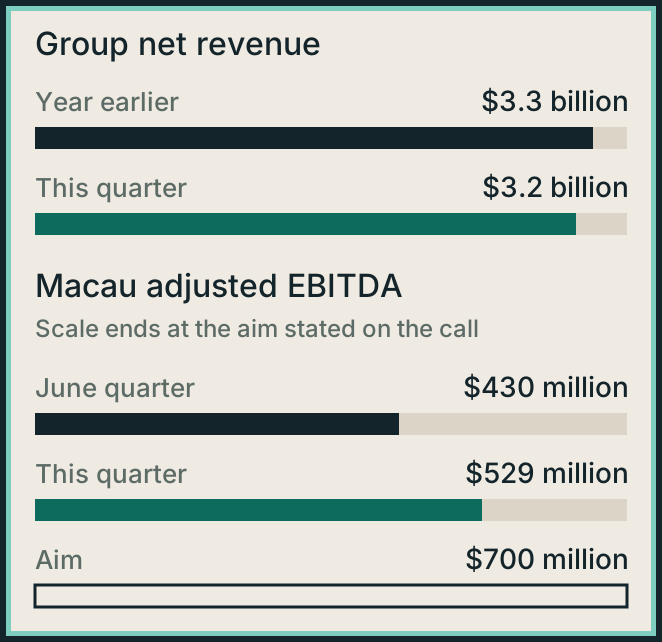
- Net revenue $3.2 billion, against $3.3 billion. Net income $352 million, against $491 million.
- Macau
- Sands China net revenue $1.93 billion, up 1.4 percent on the year and 8.4 percent on the June quarter. Adjusted EBITDA $529 million, down 12 percent on the year.
- Mass share
- 26.1 percent of mass-gaming revenue, the strongest since the fourth quarter of 2023.
- The buying
- 62 million Sands China shares for HK$793 million, about $101 million. Stake 75.56 percent. Own-stock repurchase $950 million.
- What this desk read
- CDC Gaming and two Inside Asian Gaming reports of Wednesday's results and the call. The company filing was not opened.
Las Vegas Sands reported a weaker third quarter and a busier Macau mass floor in the same set of numbers. Group profit fell. Sands China’s revenue rose. In that quarter the parent bought more of Sands China, and bought back a large block of its own stock.
The figures here come from CDC Gaming, written by Chris Sieroty, and from two Inside Asian Gaming reports by Ben Blaschke. CDC’s piece is datelined 21 October. The Macau pieces are 22 October, on results the company gave on Wednesday and on the call that followed. This desk has not opened the company’s filing. Where the two papers round one revenue figure differently, the tighter number is used and the rounding is noted.
CDC has group net revenue at $3.2 billion, against $3.3 billion a year earlier. Operating income was $618 million, against $719 million. Net income was $352 million, against $491 million. Earnings were 48 cents a share on a GAAP basis, and 54 cents after non-recurring items and asset-impairment costs. CDC says that adjusted figure missed a Yahoo Finance consensus of 68 cents, the average of 14 analysts. This desk did not open Yahoo, so the 68 cents stays CDC’s reading of it. Consolidated adjusted property EBITDA was $1.1 billion, against $1.3 billion.
Sands China does not move with the group. Inside Asian Gaming puts total net revenue at $1.93 billion for the quarter to 30 September, up 1.4 percent on the year and up 8.4 percent on the June quarter. CDC reports the same 1.4 percent rise and rounds the revenue to $1.9 billion. Net income was $191 million, against $272 million a year earlier, a fall CDC states as 29.8 percent, and against $107 million in the June quarter. Macau adjusted EBITDA was $529 million, down 12 percent on the year and above the June quarter’s $430 million.
The volume under that revenue was higher. Against the third quarter of 2025, rolling volume rose 31 percent, non-rolling drop rose 11 percent, and electronic table game handle rose 26 percent. Mass-gaming revenue share was 26.1 percent. CDC calls that the strongest since the fourth quarter of 2023. Inside Asian Gaming calls it the highest in more than three years. From the fourth quarter of 2023 to this quarter is under three years, so this note uses CDC’s dating.
By property, as Inside Asian Gaming reports it, the Venetian took net revenue of $649 million, down 6.2 percent, and adjusted property EBITDA of $205 million, down 15.3 percent. The Londoner was flat at $685 million, with EBITDA down 18.7 percent to $178 million, and the company said hold there was low. The Parisian rose 6 percent to $231 million. Plaza rose 15.6 percent to $238 million. Sands Macao took $99 million, against $72 million a year earlier. The Venetian Macao renovation is the item still ahead: CDC expects it to be finished by Chinese New Year 2028, with new premium gaming rooms, and Inside Asian Gaming has reported a plan covering all 2,900 rooms and suites, aimed at early 2028.
Marina Bay Sands went the other way. Net revenue was $1.29 billion, down 9.9 percent on the year and 6.2 percent on the June quarter. Adjusted property EBITDA was $590 million, down 20.6 percent on the year and 23.2 percent on the quarter. Patrick Dumont, chairman and chief executive, still described Singapore as solid and as the right place for high-value tourism. CDC has the next expansion, IR2, as an $8 billion standalone resort beside the existing one, on track for early 2031 if the government approvals come through. Inside Asian Gaming notes an arena in that Singapore plan.
Dumont described softness at the high end as what the quarter turned on, in both Macau and Singapore, and said it is what hurt the reported results. He did not, in Inside Asian Gaming’s account of the call, settle on one cause. The list it gives runs through the Asian economy, tourism, spending, the World Cup final on 19 July, and a general uncertainty. He also said the quarter does not show what the Singapore and Macau properties can earn. The longer Macau aim he restated is $700 million of EBITDA in a quarter, and more. This quarter’s Macau figure was $529 million.
One cost line did move against profit for a reason the company named. CDC reports the effective tax rate at 22.5 percent, against 15.6 percent, mainly the 17 percent statutory rate in Singapore. Interest expense, net of amounts capitalised, was $186 million, against $187 million. Weighted average debt was $15.5 billion, against $15.9 billion, and the borrowing cost was 4.7 percent, against 4.5 percent.
The ownership change is the other half of the week. Inside Asian Gaming reports that Las Vegas Sands bought 62 million Sands China shares in the quarter, for HK$793 million, about $101 million, and that the stake finished at 75.56 percent. Going past 75 percent meant a switch, under the Hong Kong listing rules, from the Initial Prescribed Threshold to the Alternative Threshold, so the buying could continue. The same paper says a stake above 75 percent was first disclosed in early September. In the same quarter Las Vegas Sands repurchased $950 million of its own common stock. Dumont, as CDC quotes him, included that repurchase in the return of capital to shareholders. Inside Asian Gaming puts the longer buyback at 19 percent of the stock since 2023, for a combined $6.98 billion.
On the buying, as that stake piece reports him, Dumont said the group sees value in both companies and is cutting the share count because it expects earnings and free cash flow per share to compound, particularly at current prices. On the floor, the account is that promotional spending had lagged and that money is now going into table hours, sales, marketing and service staff. Grant Chum, president, chief executive and executive director of Sands China, said the reinvestment has been steadier across the last three quarters, and that the share gains come from service and the event calendar. In these accounts, neither said the reinvestment would be slowed.
Macau revenue rose on volume and on a 26.1 percent mass share. Earnings did not: the high end was soft, and hold at the Londoner was low. The parent used the same quarter to own more of Sands China and to retire more of its own stock. The filing that would let this desk check those exhibits directly has not been opened.